
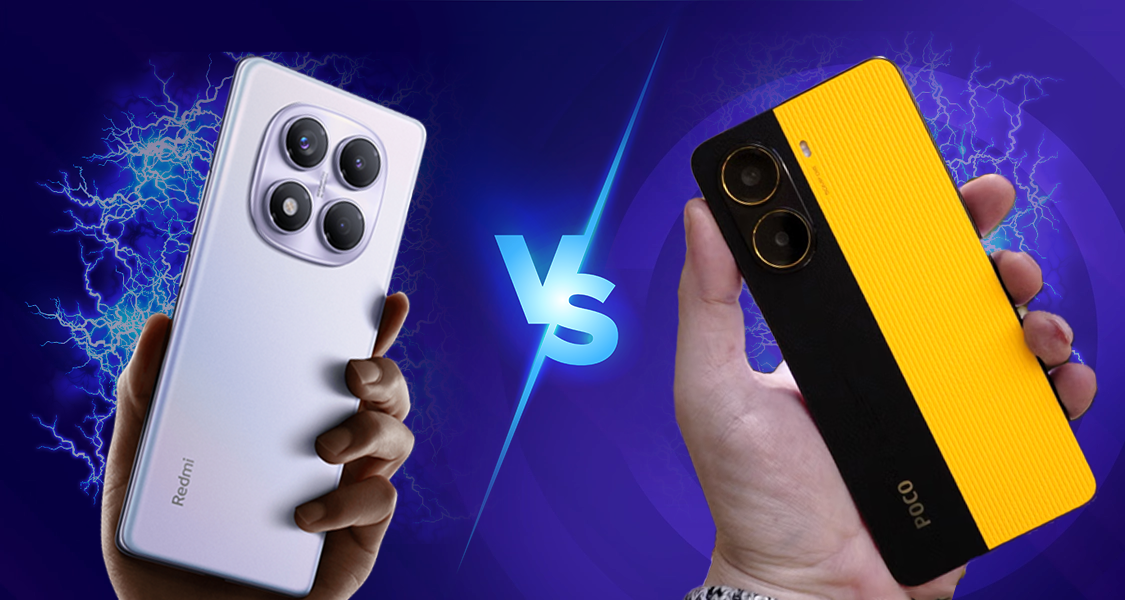
The smartphone market in Pakistan is always buzzing, and Redmi and Poco consistently make waves by offering incredible value without compromising on advanced premium features. The recent launch of the Redmi Note 14 Pro Plus and the Poco F7 Pro has ignited a considerable spark among tech lovers and those looking to upgrade their devices.
While both contenders offer flagship-level specs at competitive prices, their appeal varies based on user priorities like performance, camera, and display quality. For those seeking to buy mobiles at reasonable prices, both phones stand out as top-quality choices in the affordable premium range.
While the Redmi Note 14 Pro Plus leans toward premium build quality and advanced camera features, the Poco F7 Pro emphasizes raw performance and battery endurance. Choosing between the two can be tricky if you’re unsure what features matter most.
In this post, we’ll dissect their specs across key categories to help you make an informed decision.
AMOLED Screen & Sharpness Comparison of Redmi Note 14 Pro Plus vs Poco F7 Pro
The Redmi Note 14 Pro Plus and Poco F7 Pro feature a 6.67-inch AMOLED panel, supporting a 120Hz refresh rate and Dolby Vision. However, the POCO F7 Pro pulls ahead in terms of screen sharpness with a higher resolution of 1440 x 3200 pixels (~526 PPI) compared to the 1220 x 2712 pixels (~446 PPI) on the Redmi Note 14 Pro Plus.
This creates crisper visuals and better clarity, especially when viewing high-resolution media. While both offer excellent peak brightness levels, the Redmi Note has a slight edge with 3200 nits compared to Poco’s 3000 nits. For those prioritizing display sharpness and clarity, Redmi is the better option.
| Feature | Poco F7 Pro | Redmi Note 14 Pro Plus |
| Size | 6.67 Inches | 6.67 Inches |
| Type | AMOLED, 68B colors, 120Hz, HDR10+, Dolby Vision | AMOLED, 68B colors, 120Hz, HDR10+, Dolby Vision |
| Resolution | 1440 x 3200 (~526 PPI) | 1220 x 2712 (~446 PPI) |
| Brightness | 1800 nits (HBM), 3200 nits (peak) | 3000 nits (peak) |
| Protection | Gorilla Glass 7i | Gorilla Glass Victus 2 |
Aesthetics and Durability of Redmi Note 14 Pro Plus and Poco F7 Pro
Both devices’ design philosophy showcases modern aesthetics, but they cater to slightly different preferences. The Redmi Note 14 Pro Plus has a slightly taller and heavier build, making it feel more substantial. Its sleek curves and glass finish give it a premium look.
The Poco F7 Pro is marginally lighter and slimmer, offering a more compact feel. Both phones come in multiple color variants, but the Poco edges ahead with a slightly more compact form factor.
| Feature | Redmi Note 14 Pro Plus | Poco F7 Pro |
| Dimensions | 162.5 x 74.7 x 8.8 mm | 160.3 x 75 x 8.1 mm |
| Weight | 210 g | 206 g |
| SIM Options | Dual Nano SIM / eSIM | Dual Nano SIM |
| Colors | Midnight Black, Lavender Purple, Frost Blue |
Premium Materials of Redmi Note 14 Pro Plus vs Poco F7 Pro
Both phones offer IP68 water and dust resistance, ensuring solid durability. The Redmi Note 14 Pro Plus comes with Gorilla Glass Victus 2 on the front and a glass back, giving it a luxurious and sturdy feel. The Poco F7 Pro features Gorilla Glass 7i and comes with either a glass back or silicone polymer eco-leather, providing a stylish yet durable build. While both are tough, the Redmi uses more premium materials overall.
| Feature | Redmi Note 14 Pro Plus | Poco F7 Pro |
| Front/Back | Glass front & back, aluminum frame | Glass front/back or silicone polymer, aluminum frame |
| Protection | Gorilla Glass Victus 2 | Gorilla Glass 7i |
| IP Rating | IP68 (up to 1.5m for 30 min) | IP68 (up to 2.5m for 30 min) |
Snapdragon 8 Gen 3 vs Snapdragon 7s Gen 3
In terms of performance, the Poco F7 Pro leads due to its Snapdragon 8 Gen 3 chipset, which is built on a 4nm process and paired with an Adreno 750 GPU. It delivers high-class speed and efficiency and is ideal for gaming and multitasking.
The Redmi Note 14 Pro Plus, with its Snapdragon 7s Gen 3 and Adreno 710 GPU, is capable but not quite in the same league. So, if you’re into demanding applications or gaming, Poco is the better performer.
| Feature | Redmi Note 14 Pro Plus | Poco F7 Pro |
| CPU | Octa-core, 1 x 2.5 GHz + 3 x 2.4 GHz + 4 x 1.8 GHz | Octa-core, 1 x 3.3 GHz + 3 x 3.2 GHz + others |
| Chipset | Snapdragon 7s Gen 3 (4nm) | Snapdragon 8 Gen 3 (4nm) |
| GPU | Adreno 710 (940 MHz) | Adreno 750 |
Redmi Note 14 Pro Plus 200MP vs Poco F7 Pro’s 50MP
The Redmi Note 14 Pro Plus is the winner for photography lovers. It boasts a 200MP primary camera with multi-directional PDAF and OIS. It also includes an ultrawide and macro lens, offering more versatility.
The Poco F7 Pro, on the other hand, features a 50MP primary sensor and an ultrawide camera, which still delivers great photos but can’t match the sheer detail or versatility of the Redmi. Video recording is also more advanced on the Redmi, offering up to 8K resolution.
| Feature | Redmi Note 14 Pro Plus | Poco F7 Pro |
| Rear Camera | Triple: 200MP + 8MP + 2MP | Dual: 50MP + 8MP |
| Front Camera | 20 MP, HDR, 1080p@30/60fps | 20 MP, HDR, 1080p@30/60fps |
| Video | 8K@24fps, 4K@30/60fps, 1080p@960fps, gyro-EIS | 4K@30fps, 1080p@120fps, gyro-EIS, OIS |
Poco F7 Pro’s UFS 4.1 vs Redmi Note 14 Pro Plus’s UFS 2.2
Regarding memory, the Poco F7 Pro takes the lead with 12GB of RAM and 512GB of UFS 4.1 storage, offering lightning-fast performance and plenty of space for heavy users. In contrast, the Redmi Note 14 Pro Plus has 8GB of RAM and 256GB of UFS 2.2 storage, which is sufficient for everyday use but falls short in speed and capacity compared to Poco.
Neither device includes a microSD card slot, so internal storage is all you get. For users who multitask heavily or store large files, Poco is the better pick for speed and storage.
| Feature | Redmi Note 14 Pro Plus | Poco F7 Pro |
| RAM | 8GB | 12GB |
| Storage | 256GB (UFS 2.2) | 512GB (UFS 4.1) |
| Card Slot | No | No |
Software & Upgrade Support
The Poco F7 Pro comes with the latest Android 15 OS and HyperOS 2.0, ensuring you’re at the forefront of Google’s software innovations. On the other hand, the Redmi Note 14 Pro Plus comes with Android 14 OS and will receive up to 3 major Android upgrades, making it future-ready.
| Model | Operating System | Upgrade Support |
| Poco F7 Pro | Android 15, HyperOS 2.0 | Latest OS out of the box |
| Redmi Note 14 Pro Plus | Android 14, HyperOS | Up to 3 major Android upgrades |
Poco F7 Pro & Redmi Note 14 Pro + Price in Pakistan
Regarding pricing, both Redmi and POCO are placed in the mid-to-premium range, offering powerful features at competitive rates. However, the Redmi Note 14 Pro Plus is more budget-friendly, making it a solid choice for users looking for flagship features at a lower price.
| Model | Price in Pakistan |
| Poco F7 Pro | Rs. 185,999 |
| Redmi Note 14 Pro Plus | Rs. 136,999 |
Redmi or Poco: Which One Wins?
The Redmi Note 14 Pro Plus is a solid choice for users with a superior display and excellent camera system. It excels in multimedia and photography, offering a crisp screen and advanced imaging features.
While its Snapdragon 7s Gen 3 chipset handles routine tasks smoothly, it doesn’t quite match its opponent’s raw processing power. The Poco F7 Pro, powered by the flagship-grade Snapdragon 8 Gen 3, delivers top-class performance, making it a better fit for gamers and power users who demand speed and efficiency. It also boasts faster UFS 4.1 storage and a larger battery for extended usage.
Your decision should depend on your usage priorities; if performance and speed matter more, go for the Poco F7 Pro. However, if display quality, photography, and storage flexibility are key factors, the Redmi Note 14 Pro Plus will better suit your needs.
Stay tuned to Techbazaar for the latest mobiles, like Redmi & POCO. Explore our blog for news, expert tech advice, recent launches, in-depth reviews, and smartphone comparisons.